
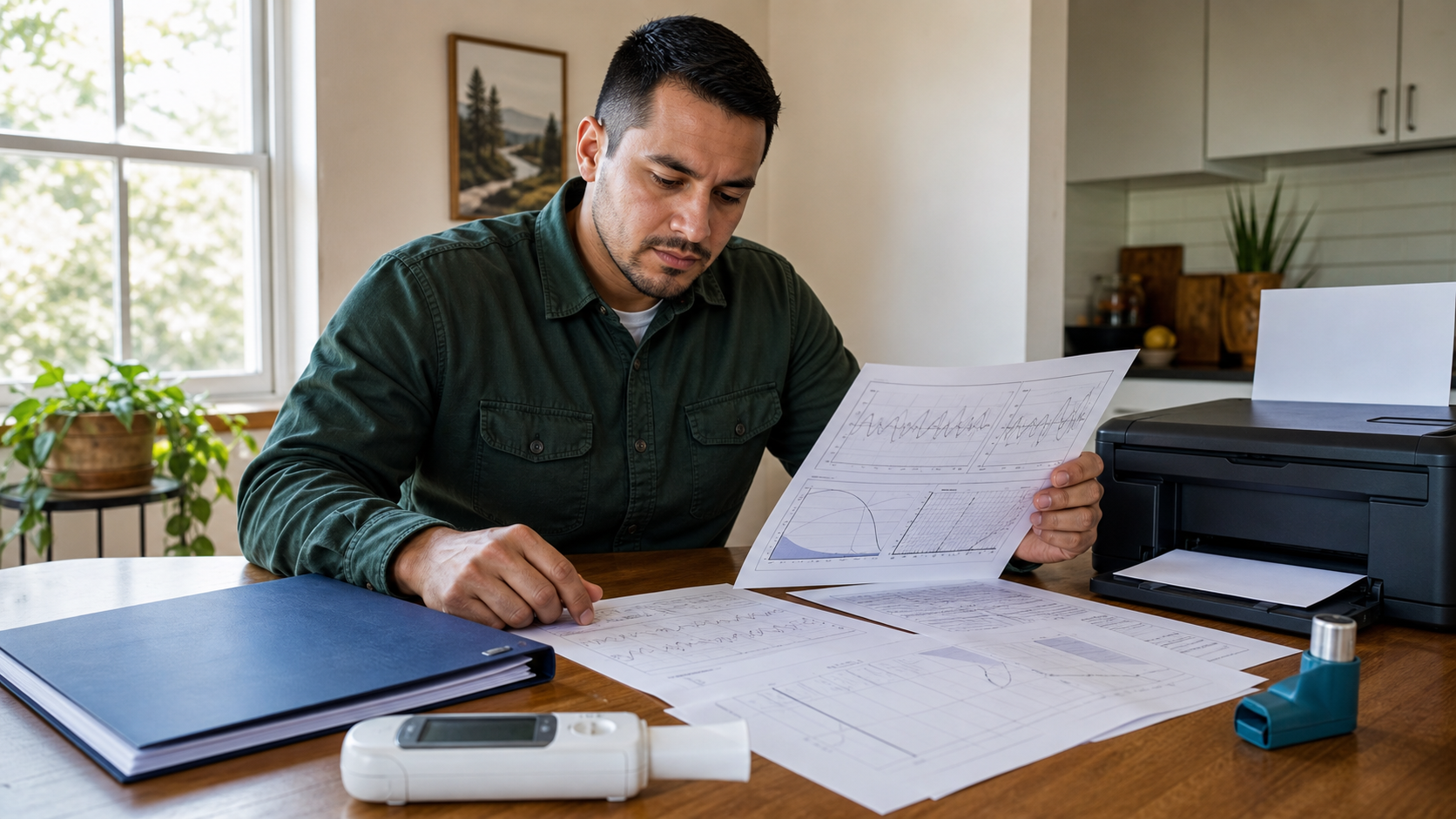
VA Asthma Claims: Understanding Your Rating
"Learn how to secure a higher VA disability rating for asthma by understanding spirometry and the importance of timing in testing."
━━━THE VETERAN'S TAKE━━━
Why Most Asthma Claims Stop at 30% (And How to Fix It)
The VA assigns asthma ratings at 10%, 30%, 60%, or 100% under Diagnostic Code 6602, and every single threshold hinges on objective spirometry numbers, forced expiratory volume in one second (FEV-1), forced vital capacity (FVC), and the FEV-1/FVC ratio, not on how many times you refill your inhaler or how often you wheeze. Most veterans file with nothing but prescription records and a statement that says "I use my rescue inhaler daily," then wonder why they're stuck at 10% ($180.42/month in 2026 for a veteran without dependents) when their actual lung function has tanked. The VA isn't going to connect the dots for you. If you don't submit spirometry results showing your FEV-1 or FVC percentages, the rater has no choice but to assign the lowest tier that fits your subjective complaints.What the Rating Criteria Actually Measure
Diagnostic Code 6602 under 38 CFR § 4.97 breaks down like this:- 10%: FEV-1 of 71-80% predicted, OR FEV-1/FVC of 71-80%, OR intermittent inhalational or oral bronchodilator therapy
- 30%: FEV-1 of 56-70% predicted, OR FEV-1/FVC of 56-70%, OR daily inhalational or oral bronchodilator therapy, OR inhalational anti-inflammatory medication
- 60%: FEV-1 of 40-55% predicted, OR FEV-1/FVC of 40-55%, OR at least monthly visits to a physician for required care of exacerbations, OR intermittent (at least three per year) courses of systemic corticosteroids
- 100%: FEV-1 less than 40% predicted, OR FEV-1/FVC less than 40%, OR more than one attack per week with episodes of respiratory failure, OR requires daily use of systemic high dose corticosteroids or immuno-suppressive medications
The Testing Gap That Kills Higher Ratings
The VA's own rating schedule acknowledges that asthma severity fluctuates, but C&P exams are one-time snapshots. If you walk into the exam breathing fine because your controller medication is working that week, the examiner documents what they see, and what they see is a veteran who appears stable. That's how veterans with documented emergency room visits for acute exacerbations still end up at 30%. The ER records prove the attacks happened, but without spirometry results from those events or within 24-48 hours after, there's no objective data showing how low your lung function dropped. You need to request spirometry testing during two windows: once during an asymptomatic period to establish your baseline, and again as close as possible to a documented exacerbation. That means calling your pulmonologist or primary care provider within a day or two of an attack and asking for a spirometry test to capture the acute impairment. If your FEV-1 drops to 48% predicted during that test, that's your 60% rating right there, even if your baseline between attacks sits at 68%.Example: How One Test Changed the Rating
Take SSgt Martinez, a veteran with service-connected asthma at 10% since 2019. He used his rescue inhaler multiple times daily and had three ER visits in 2023 for acute bronchospasm. His private pulmonologist ran spirometry during a routine follow-up in May 2024, Martinez was feeling decent that day, and his FEV-1 came back at 72% predicted. He filed for an increase, submitted that test, and the VA granted 30%. Not enough. Martinez read through the rating criteria again and realized he needed testing during an exacerbation. In August 2024, he had another severe attack and went to the ER. The next morning, he called his pulmonologist and scheduled spirometry for that same day. His FEV-1 measured 51% predicted. He filed a supplemental claim with that new result and a statement from his doctor explaining the test was conducted within 24 hours of the exacerbation documented in the ER records. The VA granted 60% two months later. The difference: $882.55 more per month, or over $10,500 annually.Secondary Conditions You're Probably Missing
Asthma doesn't exist in a vacuum. Gastroesophageal reflux disease (GERD, Diagnostic Code 7346), allergic rhinitis (DC 6522), and obstructive sleep apnea (OSA, DC 6847) are all medically recognized asthma triggers, meaning you can file for secondary service connection under 38 CFR § 3.310 if your service-connected asthma caused or worsened these conditions, or vice versa. GERD causes acid to reach the airways and trigger bronchospasm. Chronic sinus inflammation from allergic rhinitis leads to post-nasal drip that irritates the bronchial tubes. OSA disrupts sleep and worsens asthma control. Most veterans file asthma as a standalone condition and leave money on the table. If you're already service-connected for asthma and you've been treated for GERD or rhinitis since your asthma diagnosis, you need a nexus letter from a physician stating that your asthma aggravated the secondary condition or that the secondary condition worsened your asthma. That opens the door to additional ratings for each condition. A veteran at 60% for asthma who also gets 30% for GERD and 10% for rhinitis jumps to a combined rating that pays significantly more. We cover the mechanics of secondary service connection claims in depth elsewhere, but the short version: document the medical link, get a nexus statement, and file.What to Submit Right Now
If you're filing an initial claim or a rating increase for asthma, your evidence packet needs:- Spirometry results from at least two time points: one baseline and one during or immediately after an exacerbation
- A statement from your treating physician interpreting the FEV-1, FVC, and FEV-1/FVC percentages and noting whether the tests were conducted during symptomatic or asymptomatic periods
- Documentation of every exacerbation in the past 12 months: ER records, urgent care visits, prednisone tapers, nebulizer treatments
- Current medication list showing both controller and rescue inhalers with refill frequency
- Nexus letters for any secondary conditions linked to asthma
Bottom Line
Asthma ratings are decided on spirometry numbers, not symptom stories. If you're not submitting FEV-1 and FVC percentages, and if those tests weren't run during or right after an exacerbation, you're leaving higher ratings on the table. Get tested during a flare, document every attack, and file secondary claims for GERD, rhinitis, or OSA if those conditions are linked to your asthma. The difference between 30% and 60% is over $10,000 a year. Make the VA prove your lung function with objective data, and make sure that data reflects your worst days, not your best.
About FWD Assist HQ
J. Erickson is a service-disabled Air Force veteran. He served as a military firefighter and as a veteran service officer, where he spent years walking veterans through the same claims process he writes about now. He holds an MBA and writes plain-language guides for veterans who want to understand the system without a translator. Learn more about the mission.
Educational Content Only: This article is for educational purposes only and does not constitute legal or professional claims advice. If you need help with your VA claim, start by contacting your local Veterans Service Organization (VSO) -- they're free, accredited, and can represent you through the entire process. If your situation requires more specialized support, consider consulting an accredited VA attorney or claims agent.
Explore the Upcoming Library
200+ pages of step-by-step VA claim strategies, templates, and 38 CFR citations. Everything you need to file with confidence.
Related Condition Guides
From the VA Condition Library
Cardiovascular / Respiratory
Asthma and Respiratory Conditions
Respiratory conditions rated by the VA include asthma, chronic bronchitis, chronic obstructive pulmonary disease (COPD), constrictive or obliterative bronchiolitis, pulmonary fibrosis, interstitial lung disease, sarcoidosis, and others.
View GuideCardiovascular / Respiratory
Obstructive Sleep Apnea
Obstructive sleep apnea (OSA) is a condition in which the airway repeatedly collapses during sleep, causing the veteran to stop breathing dozens to hundreds of times per night.
View Guide