

VA Math: Calculate Combined Disability Ratings Easily
"The VA does not add your disability ratings the way you would expect. Here is why 50% plus 30% equals 70%, not 80%, with a pizza analogy any veteran can follow."
━━━THE VETERAN'S TAKE━━━
The call that makes every veteran angry
A veteran sits down at his kitchen table, opens his VA decision letter, and does the math in his head.
50% for PTSD. 30% for his back. 10% for tinnitus.
Fifty plus thirty plus ten. Ninety percent. He is so close to 100 he can taste it. He starts thinking about the next claim that pushes him over.
Then he reads the combined rating: 70%.
He reads it again. Same number.
He calls his VSO. He calls his buddy who used to work in claims. He Googles "VA math wrong" at two in the morning. Everyone tells him the same thing: the VA does not add ratings the way he thinks.
If you have been that veteran, this post is for you.
The short answer
The VA does not use normal addition. It uses something called the Combined Ratings Table, found in 38 CFR § 4.25. The rule is simple: each new disability only affects what is still healthy after the previous one.
Here is the pizza analogy that makes it click.
Picture a pizza
You are a whole pizza. Before any VA rating, you are 100% healthy. All slices accounted for.
Your first disability rating takes a slice of that pizza.
Say it is 50% for PTSD. The VA takes half the pizza. You now have 50% of the pizza left. That 50% is your remaining healthy portion.
Your second rating takes a slice too. But here is the move most veterans miss.
The second rating does not come out of the whole pizza. It only takes a slice of what is left.
If your second rating is 30% for your back, the VA does not take 30% of the original pizza. It takes 30% of the 50% you have left.
30% of 50% is 15%.
So your total disability is 50% (from PTSD) plus 15% (from back) = 65%.
The VA rounds to the nearest 10, so your final rating is 70%.
Not 80%. Not 90%. 70%.
Save this infographic. Share it with the veteran at your unit who thinks his rating was lowballed.
Why the VA does it this way
This is the part that helps it actually make sense.
Think about what 100% disabled means. It means you cannot work. Your body has given all it can give. If you could add ratings like regular numbers, three 40% disabilities would total 120%. But you cannot be more than 100% disabled. That is the ceiling.
The VA math keeps you from going over the ceiling no matter how many ratings you stack. Every new rating only takes a piece of what is still functional. If you are already 80% disabled, a new 50% rating cannot take half of the whole pizza, because half the pizza is not there anymore. It can only take 50% of the 20% you have left, which is 10%.
That is the logic. It is not the VA being cheap. It is math that makes sure the numbers stay honest.
How to calculate your own combined rating in three steps
Grab a calculator. Write down your ratings from highest to lowest.
Step one. Subtract your highest rating from 100. That is how much healthy pizza you have left.
Step two. Multiply that remainder by your next rating (as a decimal). That is how much more the second disability takes.
Step three. Add the two numbers. That is your new total.
Keep going for every rating. After the last one, round to the nearest 10.
Let us do a worked example.
Example: three ratings, step by step
The ratings: 60%, 40%, and 20%.
Simple math says: 60 + 40 + 20 = 120%. But the VA does not pay above 100%, so that is impossible anyway.
Real VA math:
Start at 100% healthy.
First rating, 60%. 100 minus 60 = 40. You have 40% healthy pizza left.
Second rating, 40%. Take 40% of 40. That is 16. Add it to the 60 you already lost. You are at 76% disability. You have 24% healthy pizza left.
Not sure where you stand with your VA claim?
Take the free 5-minute Claim Readiness Check and see what to focus on next.
Start the CheckThird rating, 20%. Take 20% of 24. That is 4.8. Add it to 76. You are at 80.8% disability.
Round to nearest 10. Your combined rating is 80%.
Three ratings that added to 120% on paper came out to 80% using VA math.
Skip the napkin math. Use our free VA Disability Calculator. Enter your ratings and see your combined percentage and 2026 monthly pay instantly, with the bilateral factor applied automatically.
The bilateral factor (the bonus most veterans miss)
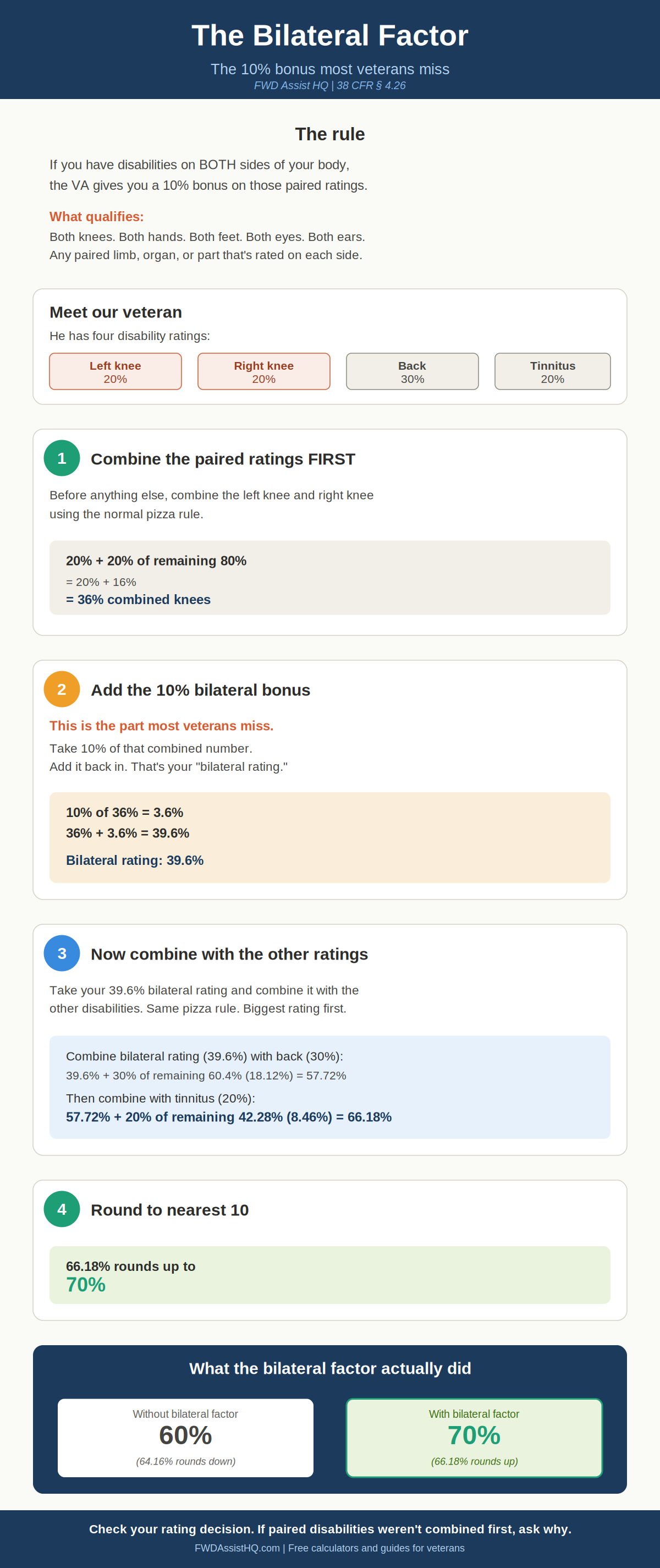
Here is something the VA will not spell out for you: if you have disabilities on both sides of your body, you get a bonus.
If you have a 20% rating for your left knee and a 20% rating for your right knee, the VA first combines those two using combined ratings math. Then it adds 10% of that combined figure back in. That total becomes one "bilateral" rating that combines with your other ratings.
It works for knees, hips, hands, feet, eyes, ears, and anything else that comes in pairs. It also works for paired conditions that cause compensatory overuse on the other side.
This bonus exists in 38 CFR § 4.26. Most veterans never hear about it.
The rounding rule
Once you have your final combined number, the VA rounds it to the nearest 10.
- Numbers ending in 1, 2, 3, or 4 round down.
- Numbers ending in 5, 6, 7, 8, or 9 round up.
A final calculation of 64.5% rounds up to 70%.
A final calculation of 64.4% rounds down to 60%.
One decimal point of a percentage can be the difference between a big payment increase and nothing. This is why every rating matters, even the small ones.
Why this matters when you file
Understanding VA math changes how you think about your claim.
Your first rating matters most. It sets the size of your remaining pizza. A 70% first rating leaves only 30% of the pizza for every future disability to affect.
Stacking small ratings will not get you to 100%. Five 10% ratings do not equal 50%. They combine to somewhere around 41% using VA math. The healthy pizza keeps shrinking, but it shrinks more slowly with each rating.
Hitting 100% almost always requires a big single rating. Most veterans who reach 100% schedular have either one 100% rating or a primary rating of 70%+ combined with several others.
Rounding is a cliff, not a slope. Every rating that gets you closer to a rounding break is worth pursuing. A 54% final calculation is the same paycheck as a 50% calculation. A 56% is the same paycheck as a 60%.
When your rating does not match what you calculated
If you just opened a decision letter and the combined rating looks off, here is what to check.
One. Did they round right? Look at the final calculation (not just the combined percentage). Near a 5? Check the rounding logic.
Two. Did they apply the bilateral factor? Pull up 38 CFR § 4.26 and see if you have paired disabilities that qualify.
Three. Did they rate every condition you claimed? Cross-reference your original claim with the decision.
Four. Did they use the right rating percentage? Compare the symptoms in your C&P exam to the VA Schedule for Rating Disabilities (38 CFR Part 4). Our Rating Criteria Lookup makes this quick.
If anything looks wrong, you have appeal options. A supplemental claim, higher-level review, or Board of Veterans Appeals review. An accredited VSO, CVSO, or VA-accredited attorney or agent can walk you through the options. That help is free. Our Appeal Deadline Calculator will tell you exactly how long you have to file.
What NOT to do
If someone promises you a specific combined rating in exchange for a fee upfront, walk away.
Under federal law (38 USC § 5905), it is illegal for anyone to charge you a fee to prepare or file your initial VA claim before you have a decision. The only people who can legally help you with an initial claim are accredited VSOs, CVSOs, and VA-accredited attorneys or agents working on contingency for appeals.
If a company is texting you, calling you, or running ads guaranteeing a rating in exchange for a "consulting fee," they are breaking federal law. Report them. Do not pay them.
For the long version, read our guide on how to spot predatory claim companies.
The free help is as good as the paid help, often better. Use the free help.
The free tools that handle the math for you
Doing VA math on paper works. Doing it in your head does not. We built a set of free calculators so you do not have to.
- VA Disability Calculator. Enter your ratings. See your combined rating, the bilateral factor applied, and your 2026 monthly payment with dependents.
- TDIU Eligibility Checker. See if you qualify for Total Disability based on Individual Unemployability. TDIU pays at the 100% rate even when your combined rating is below 100%.
- Secondary Conditions Mapper. Find service-connected secondaries you may be missing. More secondaries means more math in your favor.
- Appeal Deadline Calculator. Know exactly how long you have to challenge a rating that is too low.
All of them are free. No email required. No upsell.
Want the full picture?
Combined ratings are one chapter in a much bigger system. If you want to understand the whole thing, from how to file your initial claim to how appeals work after a denial, we wrote a book called Win Your VA Disability Claim. It is written for the veteran who just got a denial letter and wants to know what to do next. No fluff. No outcome promises. Just the system, explained plainly.
Before you close this tab
The single most important thing to remember: the VA math is not designed to cheat you. It is designed to keep the numbers honest so ratings cannot add up past 100%. Once you see the pizza, you see the system.
Now you can look at your own ratings and know exactly what to expect.
And if something does not add up, you know where to go for free, accredited help.
J. Erickson is an VA disability claims educator and Air Force and Air National Guard disabled veteran with hands-on VSO experience. FWD Assist HQ publishes VA benefits guides written by veterans, for veterans. The anti-claim-shark publisher.
Not sure where you stand with your VA claim?
Take the free 5-minute Claim Readiness Check and see what to focus on next.
Start the Check
About FWD Assist HQ
J. Erickson is a veteran and the author behind FWD Assist HQ, writing plain-language guides that help veterans understand their own VA claims. Education, not representation. No hype, no claim sharks. Learn more about the mission.
Educational Content Only: This article is for educational purposes only and does not constitute legal or professional claims advice. If you need help with your VA claim, start by contacting your local Veterans Service Organization (VSO) -- they're free, accredited, and can represent you through the entire process. If your situation requires more specialized support, consider consulting an accredited VA attorney or claims agent.
Get the Complete Playbook
200+ pages of step-by-step VA claim strategies, templates, and 38 CFR citations. Everything you need to file with confidence.
Related Condition Guides
From the VA Condition Library
Auditory / Sensory
Tinnitus
Tinnitus is a persistent ringing, buzzing, hissing, or clicking sound in one or both ears with no external source.
View GuideMusculoskeletal / Joint
Knee — Limitation of Flexion (Including Patellofemoral Syndrome)
VA rates limited knee bending under DC 5260 based on degrees of flexion lost. Patellofemoral syndrome is commonly rated here. Separately ratable from extension and instability.
View GuideMental Health
PTSD (Post-Traumatic Stress Disorder)
PTSD is a psychiatric condition that develops after exposure to actual or threatened death, serious injury, or sexual violence.
View GuideNot sure where you stand with your VA claim?
Take the free 5-minute Claim Readiness Check and see what to focus on next.
Start the Check