
Chronic Fatigue Syndrome: Maximize VA Disability Claims
"Learn how veterans can optimize VA claims for Chronic Fatigue Syndrome, ensuring higher ratings by separating symptoms effectively."
━━━THE VETERAN'S TAKE━━━
Why Most CFS Claims Cap Out at 20% When They Should Hit 60% or Higher
Veterans filing for Chronic Fatigue Syndrome (CFS) under Diagnostic Code 6354 routinely leave 30 to 60 percentage points on the table because they fail to separate constitutional symptoms from CFS-specific debility, document the wrong evidence for higher thresholds, and ignore the secondary conditions CFS directly causes. The VA rates CFS at 10%, 20%, 40%, 60%, or 100% based on symptom severity and episodic incapacitation -- but the criteria explicitly exclude constitutional symptoms like weight loss, fever, or night sweats, which must be rated separately under DC 6399-6301 or condition-specific codes. If you lump everything under one claim, you're underrating yourself before the VA even opens your file.
Here's the breakdown: a 10% rating requires debilitating fatigue with symptom reduction by non-steroidal anti-inflammatory drugs (NSAIDs) or rest. Twenty percent requires continuous medication. Forty percent requires symptoms controlled by continuous medication and minor social or occupational impairment. Sixty percent requires at least three incapacitating episodes per year, each lasting a week or more. One hundred percent requires total occupational and social impairment. The jump from 20% to 40% isn't just about meds -- it's about proving functional loss using the same language the VA borrows from mental health rating criteria under DC 9434.
The Constitutional Symptom Trap: Rate Them Separately or Lose Them
CFS often presents with constitutional symptoms: unexplained weight loss, low-grade fever, night sweats, swollen lymph nodes. The VA's rating schedule for CFS explicitly states these symptoms aren't part of the DC 6354 evaluation. They belong under DC 6399-6301 for chronic fatigue immune dysfunction syndrome or under condition-specific codes if they're manifestations of another service-connected condition.
If your Compensation and Pension (C&P) exam notes document persistent fever and you don't file a separate claim for constitutional symptoms, the examiner won't rate them under 6354. They'll note them in the narrative and move on. You'll get 20% for CFS when you should've gotten 20% for CFS plus 10% for constitutional symptoms under a different code. Combined rating math turns that into 28%, which rounds to 30%.
Example: Staff Sergeant Torres filed for CFS in April 2025 after six years of debilitating fatigue, unrefreshing sleep, and post-exertional malaise. His C&P exam documented all of it plus recurrent low-grade fever and a 15-pound unexplained weight loss over eight months. He received 20% under DC 6354. He didn't realize the constitutional symptoms were ratable separately until he read the rating decision footnotes. He filed a supplemental claim in August 2025 under DC 6399-6301 for the fever and weight loss, received 10%, and his combined rating jumped from 20% to 30%. That's the difference between $356.66 and $552.47 per month in 2026 compensation rates -- $2,350 annually he left on the table for four months.
Crossing the 40% Threshold: Why Medication Isn't Enough
The 40% rating criteria for CFS state: "symptoms controlled by continuous medication and minor social and occupational impairment." Most veterans read "continuous medication" and assume their prescription for modafinil or low-dose naltrexone checks the box. It doesn't. The second half -- minor social and occupational impairment -- is where claims stall out.
The VA borrowed this language directly from mental health rating criteria under DC 9434. "Minor impairment" means reduced reliability and productivity, occasional decrease in work efficiency during periods of significant stress, or mild impairment in social relationships. You need to document this in lay statements, buddy statements, and employment records. A prescription bottle proves you're on meds. It doesn't prove your job performance tanked or you stopped attending family events because you're too exhausted to function.
Your personal statement should include concrete examples: "I've used all 12 weeks of FMLA leave in the past year due to CFS flare-ups. My supervisor moved me from a client-facing role to back-office work because I can't maintain a consistent schedule." Your spouse's buddy statement should say: "He sleeps 14 hours on weekends and still wakes up exhausted. We haven't attended a social event together in eight months because he doesn't have the energy." That's minor social and occupational impairment. Without it, you're stuck at 20% even if you're on three medications.
Not sure where you stand with your VA claim?
Take the free 5-minute Claim Readiness Check and see what to focus on next.
Start the CheckSecondary Conditions: CFS Doesn't Exist in a Vacuum
CFS frequently causes secondary conditions that are independently ratable: fibromyalgia (DC 5025), major depressive disorder (DC 9434), and obstructive sleep apnea (DC 6847). Veterans who file only for CFS and ignore the secondaries leave massive combined ratings on the table.
A veteran with 60% CFS, 40% depression secondary to CFS, and 20% bilateral fibromyalgia secondary to CFS reaches 83%, which rounds to 80% combined. That's $2,102.15 per month in 2026 rates versus $1,435.02 for 60% alone -- an $8,006 annual difference. Each secondary requires its own nexus statement from a medical provider linking the condition to your service-connected CFS, but the payoff is substantial.
Fibromyalgia is particularly common. CFS and fibromyalgia share overlapping symptom profiles -- widespread pain, sleep disturbance, cognitive dysfunction. If your C&P exam for CFS documents tender points or myofascial pain, file a secondary claim for fibromyalgia. The VA rates fibromyalgia based on the number of widespread pain sites and constitutional symptoms. If you've got both CFS and fibromyalgia, you're rating both separately and combining them.
The Diagnosis Problem: CFS vs. Chronic Fatigue as a Symptom
VA C&P examiners routinely conflate CFS with chronic fatigue as a symptom of another condition -- hypothyroidism, sleep apnea, depression. If you walk into your exam without a formal CFS diagnosis using CDC criteria, the examiner will route your claim to the wrong diagnostic code or deny it outright as a symptom of an already-rated condition.
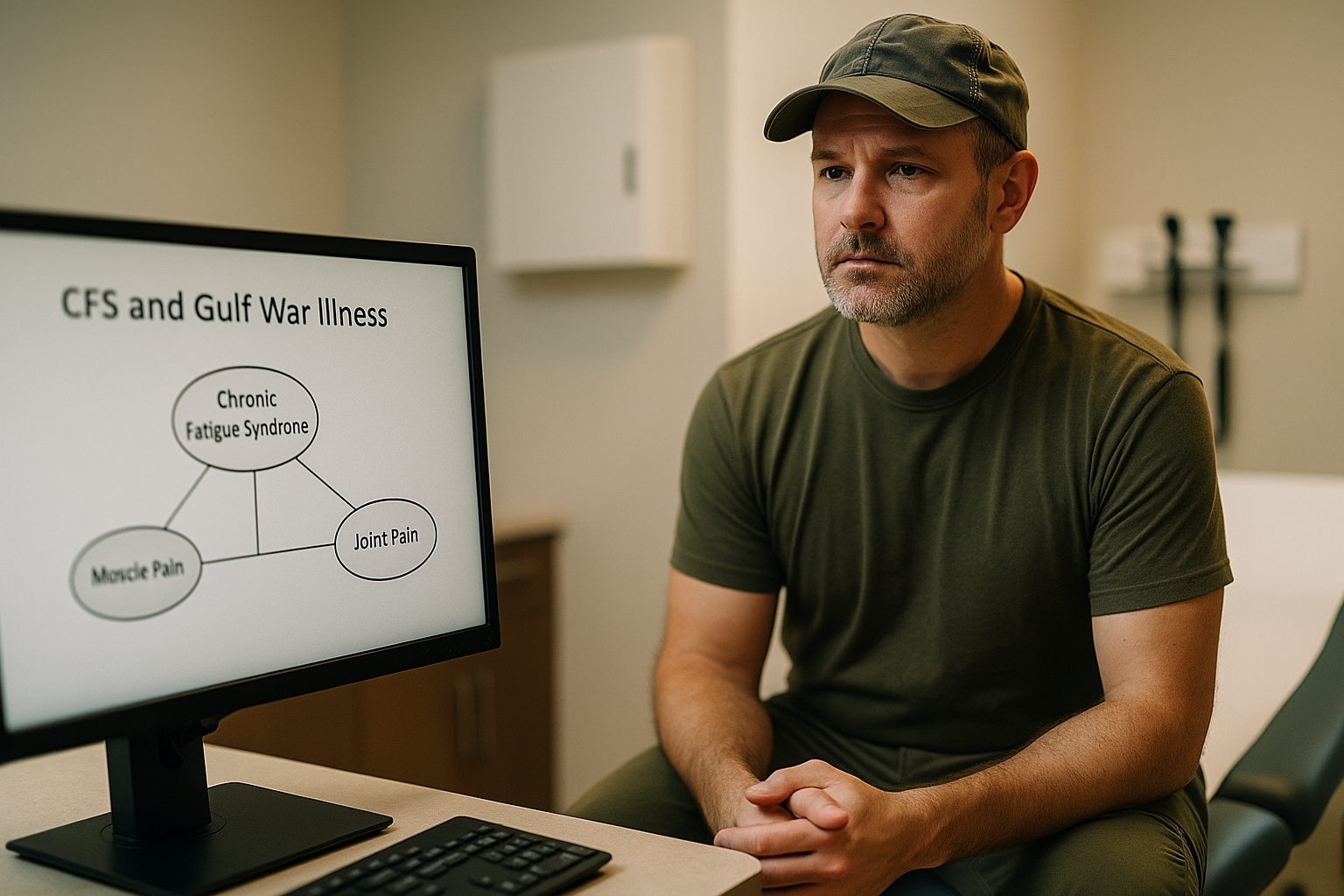
CDC criteria require debilitating fatigue lasting six months or longer plus four of eight ancillary symptoms: post-exertional malaise, unrefreshing sleep, cognitive impairment, orthostatic intolerance, muscle pain, joint pain, headaches, or tender lymph nodes. Your private provider's diagnosis should explicitly reference these criteria in your medical records. If it doesn't, request an addendum before you file your claim.
The VA isn't going to connect the dots for you. If your records say "chronic fatigue" without the formal CFS diagnosis, the examiner will attribute it to your service-connected depression or sleep apnea and deny the claim. You need the diagnosis locked down before you submit VA Form 21-526EZ.
Bottom Line
CFS claims fail when veterans treat them like a single-condition filing instead of a multi-code strategy. Rate constitutional symptoms separately under DC 6399-6301. Document functional impairment in lay statements to break the 40% threshold. File secondaries for fibromyalgia, depression, and sleep apnea within one year of your CFS decision. Walk into your C&P exam with a formal CDC-criteria diagnosis or risk having your claim misrouted entirely. The difference between doing this right and doing it wrong is 30 to 60 percentage points -- and thousands of dollars annually. If you want a step-by-step guide to building claims that actually hit the higher thresholds, grab A VA Disability Claims Manual for the Rest of Us for $9.99. It walks you through evidence checklists, personal statement templates, and exactly what the VA needs to see at each rating level. Don't leave money on the table because you didn't know the rules.
Not sure where you stand with your VA claim?
Take the free 5-minute Claim Readiness Check and see what to focus on next.
Start the Check
About FWD Assist HQ
J. Erickson is a veteran and the author behind FWD Assist HQ, writing plain-language guides that help veterans understand their own VA claims. Education, not representation. No hype, no claim sharks. Learn more about the mission.
Educational Content Only: This article is for educational purposes only and does not constitute legal or professional claims advice. If you need help with your VA claim, start by contacting your local Veterans Service Organization (VSO) -- they're free, accredited, and can represent you through the entire process. If your situation requires more specialized support, consider consulting an accredited VA attorney or claims agent.
Get the Complete Playbook
200+ pages of step-by-step VA claim strategies, templates, and 38 CFR citations. Everything you need to file with confidence.
Related Condition Guides
From the VA Condition Library
Mental Health
Major Depressive Disorder (MDD)
Major depressive disorder is a clinical diagnosis characterized by persistent depressed mood, loss of interest in activities that once mattered, changes in sleep and appetite, fatigue, difficulty concentrating, feelings of worthlessness, and in severe cases, thoughts of death or suicide.
View GuideMental Health
Sleep Disorders: Non-Apnea (Insomnia, Hypersomnia)
Insomnia and non-apnea sleep disorders are separately ratable VA conditions, often secondary to PTSD, chronic pain, or TBI. Most veterans never file for them.
View GuideEndocrine / Systemic
Hypothyroidism
Hypothyroidism is a condition in which the thyroid gland does not produce enough thyroid hormone to meet the body's needs.
View GuideNot sure where you stand with your VA claim?
Take the free 5-minute Claim Readiness Check and see what to focus on next.
Start the Check