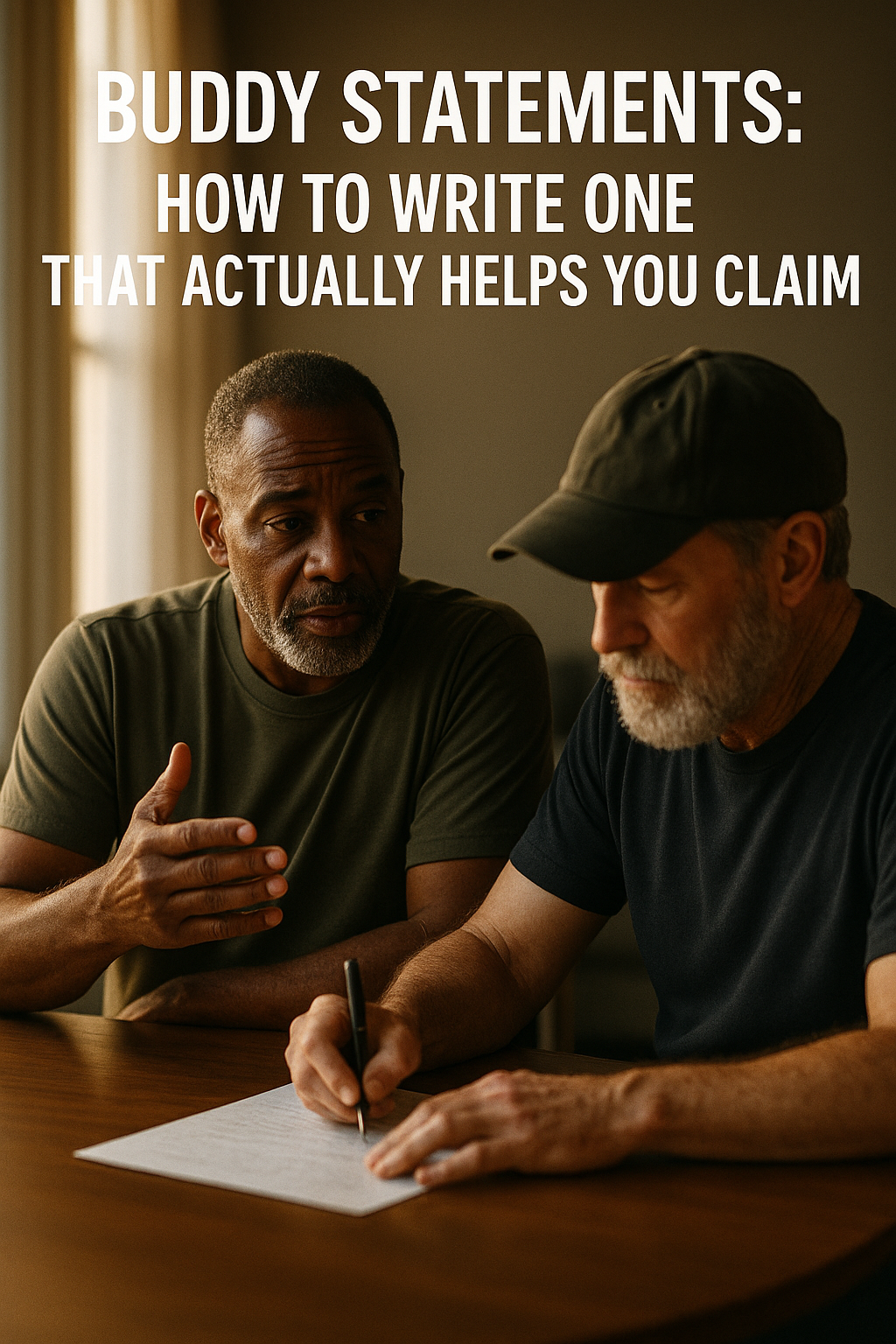
Buddy Statements: How to Write One That Actually Helps Your Claim
"A buddy statement is a written account from someone with personal knowledge of your condition or military service that supports your VA disability claim. The VA is legally required to consider such lay evidence when evaluating claims, making these statements an important part of the process."
━━━THE VETERAN'S TAKE━━━
What Is a Buddy Statement?
A buddy statement is a written statement from someone who has personal knowledge of your condition, your military service, or how your disability affects your daily life. The VA calls it a "Lay/Witness Statement" and you file it using VA Form 21-10210. This is not some feel-good exercise. Under 38 CFR 3.303(a), the VA is legally required to consider competent lay evidence when evaluating your claim.
Here's what matters: lay witnesses can testify to things they personally observed. They can describe your symptoms, behavioral changes, and functional limitations. They cannot diagnose you, but they can tell the VA what they saw with their own eyes. This distinction is critical.
Why Buddy Statements Actually Matter
The VA operates under 38 CFR 3.303(a), which establishes that lay evidence is competent evidence when it comes from people with personal knowledge. This is not optional for the VA. They must consider it. Too many veterans think buddy statements are just nice supporting documents. Wrong. They are evidence, and the VA must weigh them accordingly.
Lay witnesses fill gaps that medical records cannot. Your doctor sees you for 15 minutes every few months. Your spouse sees you every day. Your battle buddy knows how you were before deployment and how you changed after. Your coworker watches you struggle through tasks that used to be routine. These observations matter because they show the real-world impact of your condition.
The VA looks for three things in any claim: a current diagnosis, an in-service event or injury, and a connection between the two. Buddy statements can support all three elements, especially when medical records are incomplete or missing.
Who Can Write a Buddy Statement
Anyone with firsthand knowledge can write a buddy statement. This includes:
- Fellow service members who served with you
- Your spouse or family members
- Coworkers and supervisors
- Friends who knew you before and after service
- Neighbors who observe your daily struggles
- Anyone else who personally witnessed your condition or its effects
The key requirement is personal knowledge. They must have seen or experienced what they are writing about. Secondhand information does not count.
What to Include in a Strong Buddy Statement
Focus on specific, observable facts. The statement should include:
Specific observations: Describe exactly what the witness saw. "I observed John having panic attacks during formation" is better than "John seemed anxious."
Dates and timeframes: When did they observe these symptoms? How long have they known you? Be as specific as possible with dates.
Witnessed symptoms: What did they personally see? Limping, difficulty concentrating, angry outbursts, avoiding crowds, drinking heavily, not sleeping.
Changes in behavior or ability: How were you different before and after service or before and after an injury? "Before deployment, Mike was outgoing and social. After he returned, he avoided group gatherings and stayed home."
Impact on daily life and work: How do your symptoms affect your ability to function? Missing work, relationship problems, inability to perform tasks you used to handle easily.
What NOT to Include
Avoid these common mistakes that weaken buddy statements:
Medical diagnoses: Unless the witness is a medical professional, they cannot diagnose you. "I think John has PTSD" is not helpful. "I observed John having nightmares and flashbacks" is useful evidence.
Not sure where you stand with your VA claim?
Take the free 5-minute Claim Readiness Check and see what to focus on next.
Start the CheckVague statements: "He seems different" or "she's not the same" tells the VA nothing. Be specific about what changed and how.
Emotional pleas without facts: "Please help my husband" does not provide evidence. Stick to observable facts.
Information they did not witness: The statement should only include what the witness personally saw or experienced. No secondhand stories or assumptions.
Example Structure That Works
Follow this structure for maximum impact:
Paragraph 1: Identify yourself and your relationship to the veteran. How long have you known them? In what capacity?
Paragraph 2-3: Describe what you observed and when. Be specific about symptoms, behaviors, and incidents you personally witnessed. Include dates and timeframes.
Paragraph 4: Describe the impact on the veteran's life. How do these symptoms affect their work, relationships, and daily activities?
Signature and date: The witness must sign and date the statement.
Common Mistakes to Avoid
Most buddy statements fail because they are too vague, too short, or include medical conclusions the witness is not qualified to make. Do not submit a two-sentence statement that says "Joe is a good guy who deserves benefits." That helps nobody.
Another critical mistake is not using VA Form 21-10210. While the VA will accept statements on plain paper, using the official form shows you understand the process and makes it easier for the rater to consider the evidence.
Finally, avoid having witnesses guess about medical conditions or make legal arguments about why you deserve compensation. Stick to facts they personally observed.
Quality Over Quantity
Two or three strong, detailed buddy statements are worth more than ten vague ones. Focus on getting statements from people who have the most relevant observations. A battle buddy who served with you during the incident that caused your injury carries more weight than a casual acquaintance who barely knows you.
Choose witnesses who can write clearly and provide specific details. Coach them on what to include, but make sure the statement reflects their own observations and words.
Take the Next Step
Buddy statements are just one piece of building a winning VA claim. For a complete guide to gathering evidence, understanding VA regulations, and avoiding the mistakes that sink claims, check out our comprehensive resources at our books page.
This article is for educational purposes only and does not constitute legal advice. For personalized guidance on your VA claim, consult with an accredited VA attorney or claims agent.
Not sure where you stand with your VA claim?
Take the free 5-minute Claim Readiness Check and see what to focus on next.
Start the Check
About FWD Assist HQ
J. Erickson is a veteran and the author behind FWD Assist HQ, writing plain-language guides that help veterans understand their own VA claims. Education, not representation. No hype, no claim sharks. Learn more about the mission.
Educational Content Only: This article is for educational purposes only and does not constitute legal or professional claims advice. If you need help with your VA claim, start by contacting your local Veterans Service Organization (VSO) -- they're free, accredited, and can represent you through the entire process. If your situation requires more specialized support, consider consulting an accredited VA attorney or claims agent.
Get the Complete Playbook
200+ pages of step-by-step VA claim strategies, templates, and 38 CFR citations. Everything you need to file with confidence.
Related Condition Guides
From the VA Condition Library
Mental Health
Generalized Anxiety Disorder (GAD)
Generalized Anxiety Disorder is a diagnosed mental health condition characterized by persistent, excessive worry that is difficult to control and disrupts daily life.
View GuideMental Health
PTSD (Post-Traumatic Stress Disorder)
PTSD is a psychiatric condition that develops after exposure to actual or threatened death, serious injury, or sexual violence.
View GuideMusculoskeletal / Joint
Hip -- Limitation of Motion
Hip limitation of motion means the hip joint does not move through its full normal range.
View GuideNot sure where you stand with your VA claim?
Take the free 5-minute Claim Readiness Check and see what to focus on next.
Start the Check